
The correct order of skincare products is simpler than most bathroom shelves make it look. Cleanse first, apply a treatment if you use one, moisturize, and finish the morning routine with sunscreen. At night, remove makeup or sunscreen, cleanse, use a treatment only if it belongs in your routine, and moisturize.
That sequence matters because each step has a different job. Cleansing removes what sits on the surface. Treatments need reasonably clean skin. Moisturizer helps reduce water loss, and sunscreen needs to form an even protective layer before makeup or daylight exposure. More steps do not automatically create better skin...
If you have ever stood in front of the mirror holding a toner, serum, cream, and sunscreen while wondering what goes first, you are not alone. Skincare advice often turns a simple order into a maze of rules. This guide gives you a clear morning and night sequence, explains where common steps fit, and shows when skipping a step is the smarter choice.
The correct order of skincare products at a glance
The basic order is: cleanse, treat, moisturize, protect in the morning, and remove makeup before the evening cleanse. You do not need every category listed below. Start with the steps that match your skin and your actual concerns.
Morning
- Gentle cleanser or a lukewarm-water rinse, depending on how your skin feels.
- Toner or essence, only if you use one and it does not irritate you.
- Treatment or serum, if it belongs in your routine.
- Moisturizer.
- Broad-spectrum, water-resistant sunscreen with SPF 30 or higher.
- Makeup, if desired.
Night
- Remove makeup and sunscreen when needed.
- Gentle cleanser.
- Treatment or prescribed medication, if appropriate.
- Moisturizer.
- An optional final layer only when your skin genuinely needs it.
The American Academy of Dermatology's recommended order is direct: wash your face, apply medication or treatment, then apply moisturizer and/or sunscreen, followed by makeup. That is the foundation. Everything else is optional.

Step 1: Cleanse before anything that stays on the skin
Cleanser goes first because it removes sweat, oil, makeup residue, sunscreen, pollution, and other surface debris. A leave-on product cannot do its intended job if it is being applied over a layer you have not removed. That does not mean your face needs to feel squeaky or tight afterward.
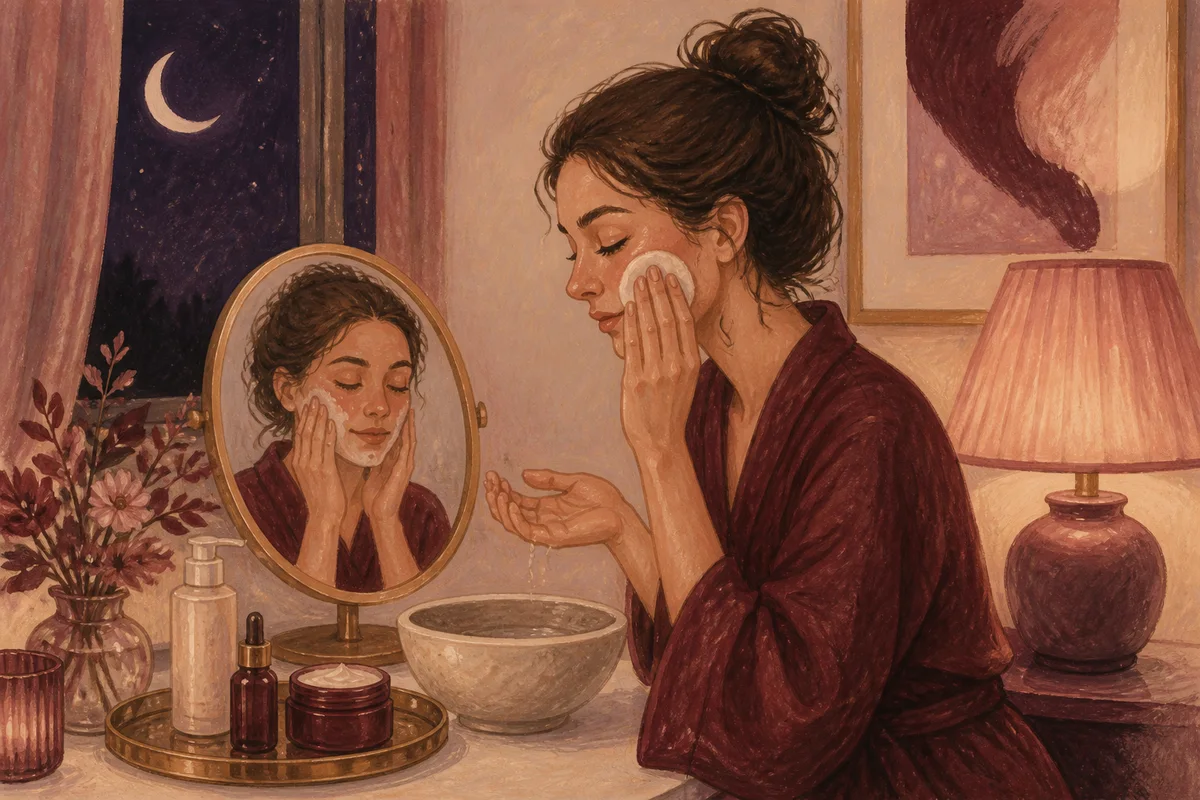
Use lukewarm water and your fingertips. Move a gentle, non-abrasive cleanser over the face without scrubbing, rinse thoroughly, and pat dry with a soft towel. The AAD's face-washing guidance recommends avoiding rough washcloths and limiting washing to twice daily and after heavy sweating.
If a morning cleanse leaves your skin dry or uncomfortable, a lukewarm-water rinse may be enough for you. If you wake up sweaty or oily, a gentle cleanse may feel better. The correct order is not a command to use more cleanser. It is a reminder that clean, comfortable skin is the starting point.
Where makeup remover fits
Makeup remover, cleansing balm, micellar water, or another first-pass method comes before your regular cleanser when you need it. Think of this as removing a layer, not adding a treatment. Use gentle pressure and avoid rubbing the eye area repeatedly.
You do not need to double cleanse every night. If your usual cleanser removes what you wore that day without leaving residue or irritation, one cleanse may be enough. Double cleansing can be useful after heavy, water-resistant layers, but it is not a badge of commitment.
Where exfoliation fits
Exfoliation comes after cleansing and before moisturizer, but it is optional. It should not be the default daily step for everyone. Scrubs, acids, and other exfoliating methods can irritate skin when used too often or layered with other strong treatments.
If you exfoliate, follow the directions for the specific formula, start slowly, and do not use it on skin that is already burning, cracked, or inflamed. The AAD warns that using too many products can irritate skin, especially when more than one anti-aging treatment is involved. Your face does not get extra credit for surviving a crowded routine.
Step 2: Apply toner, essence, or mist only if it earns its place
Toner, essence, and facial mist sit after cleansing and before a treatment or moisturizer. Their position is simple. Their necessity is not.
These steps are optional, and they should not make your skin sting, feel tight, or become more complicated to manage. If a toner adds comfortable hydration and you enjoy using it, apply a thin layer after cleansing. If it contains a strong exfoliating or acne-focused ingredient, treat it as a treatment rather than as harmless water.
Read the routine as a whole. A hydrating step may be fine, but adding a toner with exfoliating acids alongside a separate exfoliant and retinoid can create a level of irritation you did not plan for. “It is only a toner” is not a safety rule. Ingredients and frequency matter more than the name printed on the bottle.
You can also skip this category entirely. A shorter routine is easier to repeat and easier to troubleshoot when your skin changes. Honestly, that is a useful advantage.
Step 3: Apply treatments after cleansing
Treatments go after cleansing and before moisturizer. This includes a prescribed medication or a targeted leave-on step for a specific concern. If a dermatologist or product label gives different instructions, follow those instructions instead of a general internet sequence.
Apply a thin, even layer and use only the amount and frequency directed. More treatment does not mean faster results. It often means more dryness, redness, stinging, or peeling. If you are using more than one treatment, introduce changes carefully so you can identify what your skin tolerates.
Treatment order can be more nuanced than “thinnest to thickest.” A prescription may need to be applied at a particular time. Some ingredients are best used in the evening. Others can make skin more sensitive to daylight. Pregnancy, breastfeeding, medications, eczema, acne, and other conditions can also change what is suitable.
For that reason, this article does not tell you to add a particular active ingredient. It explains where a treatment generally sits once you already know it belongs in your routine. If you are uncertain, ask a qualified dermatologist or pharmacist.
How long should you wait?
For basic skincare, you usually do not need a long, fixed waiting period between steps. Allow a layer to settle enough that the next one spreads without pilling, rolling, or heavy rubbing. A minute or two is often plenty for a comfortable routine.
Follow the label when it gives a specific instruction. A prescribed treatment may have rules about dry skin, timing, or contact with other ingredients. Do not create a complicated timer system for ordinary moisturizer and sunscreen unless you genuinely need one.
Step 4: Moisturize while skin is comfortable
Moisturizer follows treatment and comes before sunscreen in the morning. It helps reduce water loss and supports a comfortable skin surface. Apply a thin, even layer to slightly damp skin if that feels good, using gentle pressure rather than rubbing hard.
Dry skin may prefer a richer texture. Oily skin can still need moisturizer, often in a lighter texture or smaller amount. Combination skin may need more on dry cheeks and less through the oily centre. Sensitive skin usually benefits from fewer changes and careful patch testing.
Moisturizer is not a reward you earn after using a strong treatment. It is part of keeping the routine tolerable. If a treatment makes your skin tight or flaky, adding more treatment is rarely the first answer. Reconsider the frequency, amount, or guidance you are following.
Do not confuse a temporary tingle with proof of effectiveness. Repeated burning, itching, swelling, or redness means you should stop and assess what is happening. A prescribed product is the exception to guesswork, so ask the prescriber if irritation is expected or requires a change.
Step 5: Sunscreen is the final morning skincare step
Sunscreen comes after moisturizer and before makeup. Choose broad-spectrum, water-resistant sunscreen with SPF 30 or higher when you will be exposed to daylight. Apply it evenly to exposed skin, including areas many people miss: ears, neck, hairline, and the backs of hands.
The AAD recommends sunscreen as part of daily skin protection, and its guidance places sunscreen after other skincare and before makeup. Reapply at least every two hours while outdoors and sooner after swimming, sweating, or towel drying, following the label.
Sunscreen is not an evening step. You do not need to apply it before bed unless a clinician has given you a specific reason. At night, focus on removing the day and keeping the skin comfortable.
What if sunscreen pills?
Pilling happens when layers roll into little flakes instead of forming a smooth surface. It can come from applying too much of one layer, rubbing too hard, using incompatible textures, or moving to the next step before the previous one has settled.
Try thinner layers, less rubbing, and a short pause between moisturizer and sunscreen. Pressing and smoothing often works better than vigorous circles. If the problem continues, simplify the routine and change one variable at a time.
Morning skincare order in full
The morning routine should prepare your skin for the day without turning the mirror into a project plan. Start with the fewest steps that solve your needs, then add only what you can explain.
A simple morning sequence
- Cleanse or rinse: Remove overnight sweat and surface oil gently.
- Optional hydrating step: Use a toner, essence, or mist only if it feels comfortable and useful.
- Treatment: Apply a targeted or prescribed step according to its instructions.
- Moisturizer: Spread a comfortable layer across the face and neck if tolerated.
- Sunscreen: Finish with broad-spectrum SPF 30 or higher on exposed skin.
- Makeup: Apply makeup after sunscreen has settled enough to form an even layer.
If your makeup includes SPF, do not assume it replaces a properly applied sunscreen layer. The amount of makeup people usually use may not provide the labeled protection. When daylight exposure matters, treat sunscreen as its own step.
Night skincare order in full
The night routine is about removal and recovery. It does not need the same protective final step as morning, but it does need a thorough and gentle cleanse when you have worn makeup or sunscreen.
A simple night sequence
- Remove makeup or sunscreen: Use a gentle first pass when your cleanser alone is not enough.
- Cleanse: Rinse away the day with lukewarm water and fingertips.
- Optional treatment: Use only a treatment that fits your concerns and instructions.
- Moisturizer: Apply enough to leave the skin comfortable, not coated and uncomfortable.
- Optional final layer: Add one only if dryness or a clinician's plan makes it useful.
There is no prize for using every step at night. If you are tired, a gentle cleanse and moisturizer are a better routine than an ambitious sequence you skip three nights later. Consistency wins this particular argument.
Where common skincare steps fit
The labels can be confusing, so here is the practical placement without turning it into a product-shopping list.
| Step | Usual position | Why it goes there |
|---|---|---|
| Makeup or sunscreen removal | Before cleanser | Loosens a surface layer that needs removing |
| Cleanser | First skincare step | Removes surface debris |
| Toner or essence | After cleansing | Adds an optional lightweight layer |
| Exfoliant | After cleansing | Uses a treatment step on clean skin |
| Serum or treatment | After cleansing, before moisturizer | Delivers a targeted leave-on step |
| Moisturizer | After treatment | Helps support comfort and reduce water loss |
| Sunscreen | Final morning skincare step | Forms the daytime protective layer |
| Makeup | After sunscreen | Sits on top of skincare |
The table shows usual order, not permission to use everything in one routine. A short routine with cleanser, moisturizer, and sunscreen can be complete. Add another category only when you know what problem it solves and how your skin handles it.
Common mistakes with skincare order
Applying sunscreen before moisturizer
For most routines, sunscreen should be the final skincare step in the morning. Putting moisturizer over it can move or thin the protective layer. If a particular formula combines moisturizing and sun protection, follow its directions, but do not add extra layers automatically.
Using treatment after moisturizer without a reason
Some people apply a treatment over moisturizer to reduce irritation, while others need it directly after cleansing. Neither approach is universal. Follow the instructions for that treatment or a clinician's plan instead of assuming every active ingredient belongs in the same order.
Scrubbing between layers
Skincare should not require force. Rubbing can irritate skin, cause pilling, and move products around instead of helping them settle. Apply thin layers and give them a moment to become comfortable.
Adding multiple strong treatments together
The correct order cannot rescue an overloaded routine. Several exfoliating, acne, or anti-aging products can still irritate skin even if you apply them in textbook sequence. Introduce one change at a time.
Treating “natural” as automatically gentle
Plant extracts and essential oils can still irritate or trigger an allergic reaction. “Natural” describes a source, not a guarantee of safety. Patch test new leave-on products and stop if you develop a reaction.
Chasing the thinnest-to-thickest rule too literally
Texture can help when you are arranging ordinary layers, but it does not override a treatment's directions. Prescription instructions, sunscreen placement, skin comfort, and ingredient compatibility matter more than trying to measure every drop by thickness.
Patch test new additions
Before adding a new leave-on product, test it on a small area rather than applying it straight across your face. The AAD recommends applying it to a quarter-sized spot twice daily for seven to ten days, using the normal amount and leaving it on for the usual length of time.
If you see redness, itching, swelling, or another reaction, wash it off and stop using it. A home test can lower the chance of a surprise, but it is not the same as medical patch testing. If a reaction is severe or does not settle, seek professional care.

When should you simplify the order?
Simplify whenever your skin starts burning, itching, swelling, cracking, or becoming persistently red. Remove the newest or strongest addition first, return to familiar gentle care, and monitor what happens. If a treatment is prescribed, contact the clinician before changing it.
You should also simplify when the routine is too hard to follow. A six-step morning routine that you complete twice a week is less useful than a three-step routine you can repeat every day. The best order is the one you can follow without rushing or rubbing.
The Beauty section has more practical, brand-free care notes, including how to know your skin type at home. Your routine should respond to your skin, not to the number of steps someone else uses online.
Frequently asked questions
What is the correct order of skincare products in the morning?
Cleanse or rinse, apply an optional toner or essence, use a treatment if needed, moisturize, and finish with broad-spectrum sunscreen. Apply makeup after sunscreen has settled. You do not need every step for a complete routine.
What is the correct order of skincare products at night?
Remove makeup or sunscreen when needed, cleanse gently, apply an appropriate treatment, and moisturize. An additional final layer is optional and should only be used when your skin genuinely needs it or a clinician recommends it.
Should sunscreen go before or after moisturizer?
For most routines, sunscreen goes after moisturizer and is the final morning skincare step before makeup. This helps it form an even protective layer. Follow the directions on a specific product if they differ.
Do I need to wait between skincare steps?
You usually do not need a long fixed wait between basic steps. Let each layer settle enough to spread without pilling or heavy rubbing. Follow specific timing instructions for prescribed or targeted treatments.
Where does exfoliation fit in a skincare routine?
Exfoliation generally comes after cleansing and before moisturizer, but it is optional and should not be used too often. Do not exfoliate skin that is already burning, cracked, or inflamed. Avoid stacking several strong treatments.
Can I skip toner or serum?
Yes. Toner and serum are optional categories, not requirements. A routine with gentle cleansing, comfortable moisturizing, and daytime sun protection can be complete. Add another step only when you can explain what it is meant to do.
Why does my skincare pill when I layer products?
Pilling can happen when layers are too thick, incompatible, or rubbed too much before they settle. Try thinner amounts, a short pause, and pressing rather than vigorous rubbing. Simplify the routine if the problem continues.
Bottom line: keep the order clear and the routine calm
Start with the sequence that holds up in real life: cleanse, treat if needed, moisturize, and protect with sunscreen in the morning. At night, remove the day, cleanse, treat only when appropriate, and moisturize. Do not let a long product list make a simple order feel like a test you can fail.
Your next step is easy. Look at your current routine, remove anything you cannot explain, and put the remaining steps in the order above. Change one thing at a time, patch test new additions, and ask a dermatologist when irritation or a persistent skin concern moves beyond everyday skincare.
For more independent notes from the MyLifeHer journal, browse the Beauty archive and keep your routine useful, gentle, and repeatable.